
| Connect & Subscribe |
 |
 |
 |
 |
Driving and Narcolepsy: Should People With Narcolepsy Get Behind the Wheel?
Written by Allyson Edwards with contributions by Kevin MortonDozing off while driving is no small thing. Sleep-related accidents have killed thousands of individuals and are a serious concern to the well-being of our society. And this is exactly the reason why the Drowsiness Is Red Alert mantra is so important to remember.
But the reason drowsiness is red alert works is that people can typically feel their drowsiness coming on. They can then heed the warning signs. But what happens when there are no warning signs? What happens when you have narcolepsy? (What is narcolepsy, you ask? Find out.)

Dr. D's Sleep Book Says...
"If the ability to stay alert while driving is threatened, the symptom must not be ignored."
The hallmark symptom of narcolepsy is the cataplectic attack, where sudden bursts of REM sleep (and thus the near-total-body paralysis that comes with it) intrude on the waking state. To put it simply, a narcoleptic patient could go from standing up, talking with friends to suddenly on the floor paralyzed, completely unable to move in REM sleep, in a matter of seconds. (See what a cataplectic attack looks like.)
Of course, some narcoleptics experience cataplectic attacks in various degrees of severity, so in mild cases the individual may just feel very weak at the knees as the muscle atonia mechanism begins to kick in.
Has this ever happened to you? Do you have narcolepsy yourself? We would love it if you shared your experiences and insights with us and our visitors.
If you have any thoughts or questions about narcolepsy and driving in particular, you can use this other form at the bottom of the page to share them.
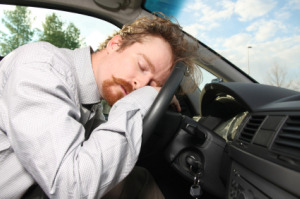 If you are ever at risk of losing your alertness while driving, you must get off the road!
Clearly the dangers of driving depend to a large degree on the severity of the symptoms, but as stated above, if the ability to stay alert could be threatened, action must be taken before it is too late.
In addition, excessive daytime sleepiness is also a very common symptom of narcolepsy. The combination of cataplectic attacks and excessive drowsiness really makes driving with narcolepsy a risky endeavor if the narcolepsy symptoms are not under control with the appropriate treatments.
Learn more about the symptoms of narcolepsy.
To conxtextualize things, let's imagine a hypothetical scenario:
You tune into the radio and listen to the hosts analyze and debate, talk and argue, and you're ready to turn it all off and start counting down from a million. Suddenly your favorite song starts to play, and you are so extremely thrilled that there's something to sing that before the first lyrics jump out of your mouth you've gone rigid and unaware of reality around you. You have no control of your body or your consciousness. Because you chose to sit behind that wheel, you are completely powerless over your own fate. In the next instant, your car could be destroyed; you could be trapped, injured, or dead.
You've lost control of your body. You've lost control of your car. For a moment, you've lost control of your life. It's just not worth it.
Driving with narcolepsy is extremely dangerous if your symptoms are not under control. Putting yourself in a situation where you run the risk of falling asleep at the wheel is, as Dr. Dement is bold enough to say, is even more hazardous than operating a vehicle under the influence of alcohol, and the numbers back this up.
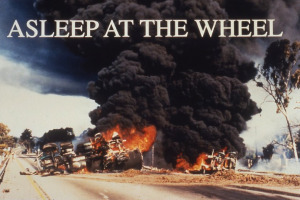 Sleep-related accidents have caused untold numbers of fatalaties on the road. If you ever feel sleepy on the road, remember that Drowsiness Is Red Alert!
According to the U.S. National Highway Traffic Safety Administration (NHTSA), approximately 100,000 motor vehicle crashes per year, as reported by authorities, involve sleepiness of the driver as the primary factor. Of these 100,000 sleep-related car accidents, approximately 71,000 involve serious injury and 1,500 result in one or more fatalities.
We absolutely cannot trust our well being or the well-being of others to the possibility of losing control on the road due to a sleep disorder. If you have narcolepsy and your symptoms are not under complete control, you must do something to prevent yourself from adding to those above statistics. If your alertness is threatened, stay off the road.
Spread the message. There is a chance that your neighbor, friend, cousin, waiter, landlord, professor, or baseball coach has narcolepsy and is risking their life every time they turn that key and fire up that ignition. Driving and narcolepsy: TOGETHER, THEY COULD KILL YOU.
Even if you don't have narcolepsy, this advice is still very applicable. Know what you're risking when you choose to drive while feeling sleepy. Death is not worth it, so always remember that on the road, Drowsiness Is Red Alert!
What's Your Take On Driving With Narcolepsy?
For the 250,000 Americans and many others around the globe affected by narcolepsy, the issue of driving is an important one. What do you think about driving and narcolepsy?
Read Other Driving and Narcolepsy Thoughts
Click on the links below to read the thoughts of others with regards to narcolepsy and driving. They were all written by other visitors to this page, just like you.
My Cousin Is Narcoleptic. So Was My Grandfather
In 1943 I spent five months in Minnesota with relatives. I rode with my grandfather to keep him awake as he drove. He nodded off quite often, but he …
Driving Off The Road, Falling Asleep, Wake Up In Morning Completely Paralyzed
In April of 1968, I was driving a 2 1/2 ton truck while in Germany. I ran off the road in the middle of the afternoon. While stationed at Fort Knox, Kentucky, …
Not Officially Diagnosed Yet - Drove and Nearly Crashed
I am sleepy almost 24x7s. I last drove around 2005/ 2006, and no longer have a car. My sleepiness has worsened since that car was sold. Also, cataplexy …
Lucky To Be Alive... Narcolepsy All Of My Life
I have had narcolepsy all my life. I am 50 years old now and although i never knew what the disease was until i was around 45 i went through most of …
Have Narcolepsy and Cateplexy
Honestly, Cataplexy is very well treated with medication in people who have Narcolepsy! I have severe narcolepsy with cataplexy although I don't quite …
Getting My Driver's License With Narcolepsy Without Cataplexy
It is very common to have narcolepsy without cataplexy. I do. It is also possible to treat narcolepsy, through medicine and maintaining good sleep hygiene, …
Cataplexy + Driving
I'm with you on this. My wife has Narcolepsy, she has no control when she will nod out, yet feels safe to drive?
I honestly think if you have Narcolepsy, …
 Subscribe To Our RSS Feed


About This Site

Welcome! This site is continuously being created by students of Dr. William C. Dement's Sleep And Dreams course at Stanford University.
We made this site as a call to action for people all over the world to live healthier, happier, safer, and more productive lives by learning about their own sleep. We have faith that reading the information provided on this site will motivate you to be smart about your sleep deprivation and strategic about your alertness in order to live life to your fullest, most energetic potential.
In fact, we challenge you to do so! What do you say, are you up for the challenge?
Interviews With Sleep Specialists: Insights Into the Worlds of Sleep Medicine & Sleep Business
America's Most Dangerous Disorder: What Is Sleep Apnea Doing To Your Sleep?
Sleep Debt: How Much More Will You Achieve When You Reduce Yours?
The Stages Of Sleep: The Journey Through The Night
Delayed Sleep Phase: You Want To Sleep But You're Not Tired Yet
Paralyzed at Night: Is Sleep Paralysis Normal?
Sleep In Words: Smart, Strange, and Funny Quotes About Sleep
Sleep Disorders In Children: What's Keeping Your Child From A Full Night's Rest?
Attacks of Pavor Nocturnus (a.k.a. Sleep Terrors, Night Terrors, or Incubus Attacks)
Learn More
The Stanford Sleep Book
Dr. Dement's pioneering textbook has been the core text for Sleep and Dreams since 1980, but it has just recently been made available to the wider public for the first time.
In it you'll find a more detailed account of the most important things you need to know about sleep, alertness, dreams, and sleep disorders. Studies, statistics, plus plenty of Dr. Dement's classic anecdotes painting the history of sleep medicine.
Preface | Intro | Contents | Get A Copy
More Sleep Resources
The Zeo
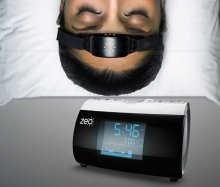

A revolution in personal sleep tracking, the Zeo is a wireless headband that transmits your brainwaves in realtime to a dock (pictured here) or your smartphone. The result? You can wake up and see exactly what stages of sleep you were in during the night! Unprecedented personalized sleep knowledge.
Sleep Paralysis: A Dreamer's Guide
Ever woken up paralyzed? A surprising number of us have, believe it or not. But few know the actual causes of this phenomenon, and fewer still how to exert control over it. Dream researcher and sleep paralysis expert Ryan Hurd shares breakthrough insights into how to do just that.
Important Disclaimer
Please Note:
The information found on this page and throughout this site is intended for general information purposes only. While it may prove useful and empowering, it is NOT intended as a substitute for the expertise and judgments of healthcare practitioners.
For more info, see our
Terms of Use.
How did we make this website?
Looks like magic, right?

You can learn how to make a great website too. Find out how!