
| Connect & Subscribe |
 |
 |
 |
 |
The following is a visitor-submitted question or story. For more, you can submit your own sleep story here, or browse the collection of experiences and questions other visitors have shared here.
Recovering from Long Term Sleep Deprivation and DSPS
by Lauren
(Lafayette, LA)
Aphasia-like symptoms felt in long-term sleep dep recovery
|

|
I am a 28 year old female, American. I am currently on Day 19 of trying Sleep Deprivation Therapy in a last ditch effort to balance my sleep. I've been struggling with DSPS for about 3 years now. It has negatively altered my life in every way.
Before I began having sleep problems, I more or less slept well, usually 7-8.5 hours a night at a socially acceptable time. I would wake up anywhere from 5 to 35 times in a night, but would always go right back to sleep and felt refreshed as long as I slept a little longer on the nights when I woke up more often. (Sleep apnea runs in my family. My Dad has it, and his Dad had it. I've never undergone the testing to be diagnosed, but I assume I have mild sleep apnea as well.) I've been this way ever since I can remember, my body adapted, and I never really considered it a problem. An annoyance, perhaps, but nothing that detracted from my overall sleep quality or ability to function. Also noteworthy is that I had night terrors as a small child, from about 3-6 years old. I have only few and vague memories of this, but my parents have told me stories.
My insomnia problems began when I was going through a divorce in 2008. My anxiety levels were so high, and I had adrenaline pumping through my body all the time, I was lucky to get 2-3 hours of sleep a night. This pattern lasted for about 6-8 months, through the duration of the crisis. I was like the walking dead. I moved in with my best friend, and it was all I could do to hold down a simple job waiting tables to pay the bills. I'd be up all night worrying, finally fall asleep around 6-8am, then have to wake up at 9am to be at work for 10am. When working a split shift (which I did several days a week) I'd force myself to get to work for 10am, pass out from 2:30pm to 4:30pm, work again from 5pm-11pm, and be awake til 6am-ish, repeat.
Once my crisis passed, I began being able to sleep a little bit earlier, but never earlier than 2am, and most often naturally falling asleep between 3am and 5am. Left to myself, (no alarms) I'd sleep a full 7-9 hours, fairly soundly (waking sometimes, as was "normal" for me, but falling right back asleep). Unfortunately, I then got a "real" job that required me to roll into the office sometimes as early as 7am (at least once a week) and usually between 8:30am and 9am. This is where I believe my condition became chronic.
It became normal for me to only get about 3-6 hours of sleep on a regular basis, and then I'd crash hard on the weekends (getting 8-12 hours of sleep Saturday and Sunday) to compensate. That's when I started doing sleep research and really got good sleep habits (dark room, using bed only for sleep and sex, monitoring caffeine and alcohol in relation to bedtime, all that jazz). I've had excellent exercising habits since 2006 (exercising 3-6 times a week for at least 30 minutes a day).
Then I was let go from my job (downsizing, economy) and decided to go back to school to earn my Masters degree. (Fall 2010) THIS is where things REALLY began to become unbalanced. I got the crazy notion that trying a poly-phasic or bi-phasic sleep schedule was the greatest idea in the world. Poly-phasic didn't really work, but I really enjoyed the bi-phasic schedule. It felt really natural to go to sleep from about 4am and sleep til 9am (sometimes 5-10am, or 6-11am), then take a nap from about 2pm-5pm, 3-6pm or 4-7pm. This schedule really felt natural, I fell asleep fairly easily at these times and felt rested upon awakening. Unfortunately, it is NOT socially acceptable to say, "Gee, sorry Dr. Professor, I can't meet you at this time/attend class cause I have to take a nap." So, on days when I had obligations during the mid-afternoon (about half the week) I would just be sleep deprived. Unfortunately, this did not result in my falling asleep any earlier at night. I generally had to be at school for 11am, and had a class one night from 6-9pm. These class hours are not going to change much for me for the duration of my graduate school program (I have 1.5 to 2 years left).
I began to accrue, little by little, a massive sleep debt. I questioned what was different from this time as opposed to when I was sleep deprived in 2008-09, and realized that back then I had crisis-related, adrenaline/survival hormones pumping through my body. Now I was just living real life.
I began to compensate by, once again, sleeping ridiculous amounts of hours on the days when I did not have to be somewhere (usually Friday, Saturday, and Tuesday evening/mornings), and obscenely small hours on class days (Sunday, Monday, Wednesday and Thursday evening/mornings). Typical of this time (August 2010 to May 2011) would be to sleep 3-4 hours a night 4-5 nights a week, nap any time I could (upwards of 2-3 thirty minute to two hour naps a day) and then CRASH
Being a student, I am/was broke, and could not afford to see a sleep specialist, but thankfully, a sleep center here in town offers a free, bi-annual sleep seminar and consultation. I was able to talk to the sleep doctor, and showed him my sleep journal charts I kept (I use the program Sleep Chart, available here: http://www.supermemo.com/articles/sleepchart.htm).
Naturally, he couldn't give me an official diagnosis without my going in overnight for observation/monitoring, but he agreed with me that my history and sleep patterns suggested that I had developed DSPS. We went over various methods, etc, commonly used to overcome DSPS and get on a regular sleep schedule and I replied to all, "Tried that, and that, THAT didn't work at all, that one worked for a week or so..." and etcetera. Then he said, "Well, there's only one thing it seems that you haven't tried." I cringed when he said this, and thought to myself, "Not Sleep Deprivation Therapy, anything but Sleep Deprivation Therapy..." Of course he said Sleep Restriction Therapy (which is the same thing). You can view the document he sent me here: https://docs.google.com/document/pub?id=1nNocnqee2Rcxj52AV1FNyL0ib2dY6YyCXDUZDeNAuj8
He warned me that I should attempt to implement this program when I didn't have a ton of stuff going on (ex.: not during finals). This was March 2011, so I just struggled through the rest of the semester (I am lucky that my professors are amazing and very understanding), and am now on day 19 of waking up at 8am everyday, no naps. I am keeping a daily blog of my journey through Sleep Deprivation Therapy here: http://recoveringinsomniac.tumblr.com/
Whew! THAT was a ton of background information. If you made it through all that, my question is this: Where can I find information on what happens to a person's brain when recovering from long-term sleep deprivation? Because the progress and changes I see and feel going on in myself are pretty amazing. I would love to read about other people's journeys through similar processes, so that I can anticipate what to expect.
The first two weeks I was pretty much a "normal" sleep deprived zombie, and exhibited the usual symptoms (inability to focus, moodiness, depression, lack of energy, mild hallucinations, etc). Then, on Day 14, I noticed a marked change: I slept for 8 hours, at a normal time (12am-8am), didn't feel foggy when I woke up, and was energetic for a good part of the day. WOW.
Since then (has it really only been five days??? Time and space seem to blend together in the strangest of ways recently...) I seem to be able to function "normally" (as in, how I functioned pre-sleep problems), but only for a limited time each day. The amount of time I am able to function normally appears to lengthen from 30-60 minutes each day since I made it to day 14 of the Sleep Deprivation Therapy.
HOWEVER, the strange thing is that I _know_ that this is still not me at 100%. The strangest thing is that I experience a sort of aphasia (but it does not fit any variation of definition of aphasia that I have found).
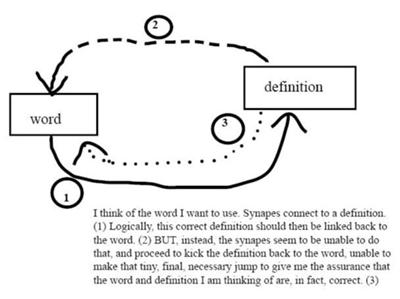
The phenomena is this: I seem to have problems concretely connecting words to their definition. It’s the strangest thing, and not normal for me at all. It’s like, I know the word, or a word that is spelled/pronounced very close to the right word (e.g. I want to say "proactive" but I immediately dismiss that word and cycle through a list of similar sounding words like "precursor", "premonition", "preamble", etc.) and I have a definition that I know is connected somehow to that word (it always ends up actually being the definition of the word), but my brain doesn’t make that final, solid connection to let me use it. I guess it’s like something being on the tip of your tongue, but it’s different somehow. I can literally feel something happening in my brain when this happens, and can identify and physically point to the area of my brain when it happens.
The area of the brain I "feel" working is on both sides of my brain, although more often on the left side, directly in-between my temple and my ear, and up about 1/4-1/2 an inch. While I like, and am fascinated by neuroscience, I am by no means an expert. Google tells me that this area of the brain is the pre-motor cortex, and seems more specifically to be Broca's Area, which is related to speech and language. I drew a picture of what it feels like. (see uploaded picture). In addition, I notice that when I am struggling to make this connection, my eyes look directly upwards, not to the left or right. (I know that there have been some studies done on eye movements and direction and memory recall.)
Does this make any sense, or is it just another sleep deprivation crazy feeling? I am thankful for any and all insight you can give me!
Thanks in advance,
Lauren
Comments for Recovering from Long Term Sleep Deprivation and DSPS
|
||
|
||
|
||
|
||
|
||
|
||
|
||
|
||
|
||
|
||
|
||
|
||
|
||
 Subscribe To Our RSS Feed


About This Site

Welcome! This site is continuously being created by students of Dr. William C. Dement's Sleep And Dreams course at Stanford University.
We made this site as a call to action for people all over the world to live healthier, happier, safer, and more productive lives by learning about their own sleep. We have faith that reading the information provided on this site will motivate you to be smart about your sleep deprivation and strategic about your alertness in order to live life to your fullest, most energetic potential.
In fact, we challenge you to do so! What do you say, are you up for the challenge?
Interviews With Sleep Specialists: Insights Into the Worlds of Sleep Medicine & Sleep Business
America's Most Dangerous Disorder: What Is Sleep Apnea Doing To Your Sleep?
Sleep Debt: How Much More Will You Achieve When You Reduce Yours?
The Stages Of Sleep: The Journey Through The Night
Delayed Sleep Phase: You Want To Sleep But You're Not Tired Yet
Paralyzed at Night: Is Sleep Paralysis Normal?
Sleep In Words: Smart, Strange, and Funny Quotes About Sleep
Sleep Disorders In Children: What's Keeping Your Child From A Full Night's Rest?
Attacks of Pavor Nocturnus (a.k.a. Sleep Terrors, Night Terrors, or Incubus Attacks)
A Note On Visitor-Submitted Questions:
Publishing sleep stories and questions from our visitors is meant to create a forum for open and proactive dialogue about an extremely important portion of our lives (one that occupies 1/3 of it and affects the other 2/3) that isn't talked about enough. It is not meant to substitute a trip to the doctor or the advice of a specialist. It's good to talk; it is not good to avoid consulting someone who's profession it is to help you with this kind of stuff.
If you are in any way concerned about your sleep health, don't wait for an answer on here, and don't necessarily rely on them. See a sleep specialist in your area as soon as possible.
The Stanford Sleep Book

Dr. Dement's pioneering textbook has been the core text for Sleep and Dreams since 1980, but it has just recently been made available to the wider public for the first time.
In it you'll find a more detailed account of the most important things you need to know about sleep, alertness, dreams, and sleep disorders. Studies, statistics, plus plenty of Dr. Dement's classic anecdotes painting the history of sleep medicine.
Preface | Intro | Contents | Get A Copy
More Sleep Resources
The Zeo
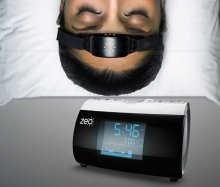

A revolution in personal sleep tracking, the Zeo is a wireless headband that transmits your brainwaves in realtime to a dock (pictured here) or your smartphone. The result? You can wake up and see exactly what stages of sleep you were in during the night! Unprecedented personalized sleep knowledge.
Sleep Paralysis: A Dreamer's Guide

Ever woken up paralyzed? A surprising number of us have, believe it or not. But few know the actual causes of this phenomenon, and fewer still how to exert control over it. Dream researcher and sleep paralysis expert Ryan Hurd shares breakthrough insights into how to do just that.
Important Disclaimer
Please Note:
The information found on this page and throughout this site is intended for general information purposes only. While it may prove useful and empowering, it is NOT intended as a substitute for the expertise and judgments of healthcare practitioners.
For more info, see our
Terms of Use.